

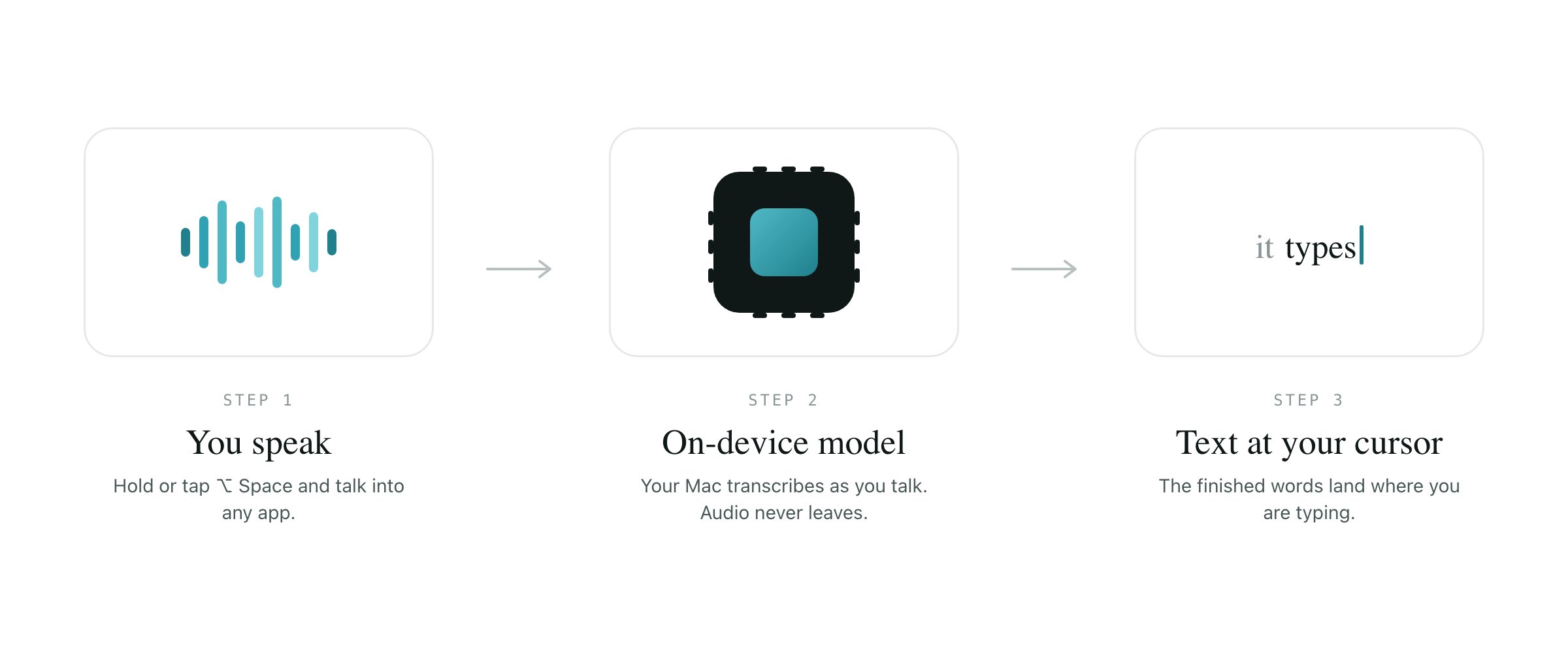
The user-facing loop: speak, transcribe on-device, land the text at your cursor.
/sig) expand, and the injector places the final text at the cursor. History keeps the raw transcript untouched alongside the final text.
The crates
rekody-core is the orchestrator. It wires the other five crates into the pipeline, owns configuration and the setup wizard, and carries the CLI surface: the live console, history and config TUIs, skills, prompts, snippets, per-app context detection, and the training-data recorder.
rekody-audio captures microphone audio via cpal, resamples it to 16kHz mono via rubato, and applies energy-based voice activity detection so silence never reaches the speech engine.
rekody-stt is a trait-based abstraction over speech-to-text backends: the Rekody Streaming engine, local Whisper via whisper.cpp (with Core ML acceleration on Apple Silicon), and the Deepgram, Groq, and Cohere engines. Engines are swappable behind one interface, which is what makes stt_engine a one-line config change.
rekody-llm turns raw transcripts into polished text. It implements the provider presets plus custom OpenAI-compatible endpoints, chained with automatic failover: providers are tried in order, the first success wins, and a final raw-transcript tier guarantees dictation always returns text.
rekody-inject places the finished text at the cursor, either by clipboard paste (works everywhere) or by native CGEvent keystroke injection.
rekody-hotkey listens for the global hotkey using an active macOS CGEventTap. Active means the tap suppresses ⌥ Space before it reaches the focused app, so dictating never types a stray non-breaking space. This is the crate behind the Accessibility permission requirement.
Where things live on disk
Config and history files are written with mode
0600, readable only by the owning user.